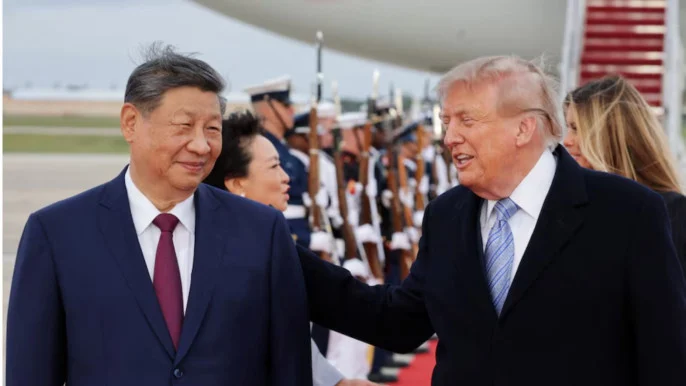
WASHINGTON — US President Donald Trump greeted Chinese President Xi Jinping upon his arrival yesterday evening (23 September), marking the first time a US president has personally welcomed a foreign leader at Joint Base Andrews in 11 years, when President Barack Obama welcomed Pope Francis in 2015, according to C-SPAN, which tracks presidential events.
The gesture set the stage as President Trump welcomes President Xi to the White House today (24 September) for a lavish state summit expected to be heavy on symbolism but light on substance, with both leaders keen to showcase stable ties despite a deep underlying rivalry.
It marks the second meeting this year between the leaders of the world’s two largest economies, but represents Xi’s first visit to Washington in more than a decade.
In an arrival statement carried by China’s Xinhua news agency, Xi expressed hope for a more stable relationship with the United States, stating that Beijing and Washington should be “partners, not rivals” and emphasizing that the “historical logic of peaceful coexistence” between the two nations remains unchanged.
For Trump, who relishes ceremony and values his connections with powerful leaders, the visit is as much a matter of national prestige as an opportunity for high-stakes diplomacy.
The US president aims to reciprocate the grand welcome he received in China in May by honoring Xi with a ceremonial reception spanning the White House South Lawn, State Floor, and Rose Garden.
Major breakthroughs, however, are not anticipated.
Analysts indicate that tangible outcomes will likely be confined to extending a trade truce expiring in November and agreeing to assess the potential threats posed by artificial intelligence.
US Treasury Secretary Scott Bessent told Fox News on Wednesday, following discussions with Chinese Vice Premier He Lifeng, that both sides had agreed to extend a trade war pause until 10 January, maintaining a hold on mutual tariffs that had topped 100%.
Sources familiar with the preparations indicate the talks could also produce agreements to lower select tariffs, curb drug trafficking, and expand military-to-military dialogue, while Trump is expected to press for the release of Americans and other foreign nationals detained in China.
Former Deputy Secretary of State Kurt Campbell noted that the summit is less about substantive negotiations and more about two formidable leaders projecting strength.
“This is really the historical reincarnation of what we often referred to in antiquity as single combat — really powerful guys, each representing their civilisations, kind of measuring and going toe to toe,” Campbell remarked.
Maintaining Stability
Xi enters the talks from a position of strength, having overseen a surge in Chinese trade while maintaining tight control over global rare earth mineral supplies, providing Beijing with significant leverage.
Both leaders see advantages in keeping relations stable: Trump is currently entangled in the unpopular war with Iran, while Xi is navigating domestic economic headwinds.
Yet beneath the ceremonial surface lie persistent friction points that could reignite tensions, including disputes over Taiwan, technology export controls, and AI development.
Taiwan, a democratically governed island claimed by China, remains the most sensitive point of contention.
US allies across Asia have voiced concern that Trump might soften Washington’s backing of Taipei to secure economic concessions from Beijing.
Sources briefed on the matter told Reuters that Xi is expected to press Trump to halt arms sales to Taiwan, a request he may raise during a planned joint visit to the US National Archives on Friday. In return, China is offering to assist in pressuring Iran, according to the sources.
Following their May summit, Trump stated he was holding a $14 billion arms package for Taiwan in abeyance, describing it as a “very good negotiating chip”.
While the leaders are expected to address the Iran conflict, there is little indication that Beijing is prepared to pressure its ally to accede to US demands, despite the disruption the fighting has caused to international energy supply chains and trade.
Potential Trade Agreements
Trade presents a more promising avenue for progress.
With midterms approaching, Trump is eager for economic victories. US Trade Representative Jamieson Greer stated earlier this month that both nations are preparing “some announcements on agriculture and non-tariff barriers”.
Greer noted on Monday that China is making progress on its commitment to purchase 200 Boeing aircraft, though he gave no signal that additional orders were imminent.
Analysts also highlight AI as a potential area for cooperative framework, given its profound implications for national security, economic competitiveness, and military capability, as well as shared concerns in Washington and Beijing regarding misuse.
Bessent discussed AI with He Lifeng over the weekend, and US Secretary of State Marco Rubio noted preliminary discussions regarding “the equivalent of a hotline that we had during the Cold War” to prevent dangerous incidents that “could impact economies or societies and even lead to a conflict between nation-states”.
However, experts caution that intense bilateral competition in AI will likely restrict agreements to largely symbolic measures.
The guest list for tomorrow’s state dinner includes prominent tech executives, including Apple’s Tim Cook, Amazon’s Jeff Bezos, Alphabet’s Sundar Pichai, OpenAI’s Sam Altman, Tesla’s Elon Musk, and Nvidia’s Jensen Huang. Despite their attendance, sources familiar with US strategy indicate Trump is likely to maintain stringent export controls on advanced US technology—restrictions Xi is eager to see relaxed.