The cost of transporting goods to and from Khatunganj, one of Bangladesh’s largest wholesale markets for consumer goods, has started rising following a Tk 20 per litre increase in fuel prices.
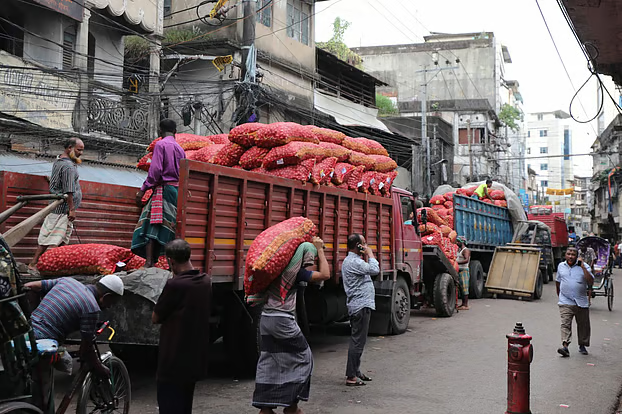
Truck driver Mohammad Masud arrived in Khatunganj on Tuesday afternoon carrying onions from Pabna. According to him, a truck travelling from Pabna to Chattogram and back consumes around 220 litres of diesel.
With diesel now Tk 20 more expensive per litre, the round trip will cost him an additional Tk 4,400 in fuel alone.
The higher fuel costs are already being reflected in transport fares.
A truckload of onions arrived at the warehouse of Mohammad Idris, president of the Khatunganj Hamidullah Mia Market Welfare Association, from Pabna on Tuesday. Before the fuel price increase, the transport charge for a truck from Pabna was Tk 28,000. On Tuesday, the same trip cost Tk 32,500—an increase of Tk 4,500.
Transport costs from Kushtia to Khatunganj have also increased.
According to a trader, the transport charge for a truck from Kushtia to Khatunganj was previously Tk 32,000. After the new fuel prices came into effect, transporters are demanding up to Tk 40,000 for the same route—an increase of Tk 8,000.
The organisation representing goods transport owners said transport charges for sending goods from Chattogram to Dhaka and Savar have also increased by up to Tk 5,000.
The Tk 20 increase in fuel prices has therefore begun pushing up the cost of bringing goods to Khatunganj from different parts of the country and sending them from the wholesale market to other destinations.
Traders fear the additional transport costs could eventually be added to the prices of essential commodities such as rice, lentils, onions, garlic and ginger.
Khatunganj and the nearby Chaktai and Asadganj areas are major wholesale markets for rice, lentils, edible oil, sugar, wheat, onions, garlic, ginger and various spices.
Goods arrive at these markets from different parts of the country. At the same time, large quantities of imported consumer goods entering through Chattogram Port are distributed to different parts of Bangladesh through these markets.
As a result, higher fuel costs are affecting transportation from both directions. Traders are paying more to bring goods from production areas to Khatunganj, while the cost of sending goods from Khatunganj to Dhaka, Savar and other destinations has also increased.
Transport fares depend on several factors, including distance, truck type and capacity, the volume of goods, demand for vehicles and whether the truck can secure a return load. Therefore, transport charges can vary even for similar distances.
Truck driver Mohammad Masud, who came from Pabna, said a round trip between Pabna and Chattogram requires around 220 litres of diesel.
At the new price, buying the same amount of diesel will cost Tk 4,400 more than before. In his case, the additional fuel cost is roughly similar to the increase in the truck fare.
Nurul Islam, manager of M/S Borkot Bhandar, a wholesale business dealing in onions, garlic and ginger, said they paid Tk 32,000 to bring a truckload of goods from Kushtia last Sunday.
After the new fuel price took effect, transporters are demanding Tk 40,000 for the same route—an increase of Tk 8,000.
“Traders cannot absorb the higher transport costs from their own pockets. The additional cost will eventually be added to the price of the goods,” Nurul Islam said.
“Depending on the product, we estimate the impact could be Tk 1 to Tk 5 per kilogram. Once wholesale prices increase, the impact will also reach the retail market.”
Khatunganj supplies rice, lentils, edible oil, sugar, wheat, onions, garlic, spices and almost all types of consumer goods to Dhaka.
As a result, an increase in transport costs along this route will not be limited to the Chattogram market.
According to Roads and Highways Department (RHD) data, the road distance between Dhaka and Chattogram is around 264 kilometres. However, the actual distance varies depending on the specific destination in Dhaka where goods from Khatunganj are delivered.
Based on RHD calculations of vehicle operating costs, a medium-sized truck may require around 50 litres of diesel for a 250-kilometre journey, while a heavy truck may require around 62.5 litres.
With diesel prices rising by Tk 20 per litre, this would mean an additional fuel cost of around Tk 1,000 for a medium truck and Tk 1,250 for a heavy truck on a one-way trip. For a round trip, the additional cost would be around Tk 2,000 to Tk 2,500.
However, this is an estimated calculation. Actual fuel consumption varies depending on the size and engine of the vehicle, the weight of the goods, traffic congestion and driving conditions.
Truck driver Mahibur Rahman regularly transports goods from Khatunganj to Karwan Bazar in Dhaka. He said his large truck consumes around 100 to 110 litres of diesel for a round trip.
According to his calculation, the Tk 20 increase in diesel prices means an additional Tk 2,000 to Tk 2,200 in fuel costs for each round trip.
However, transport fares are not increasing strictly in line with the additional fuel costs.
Chowdhury Zafar Ahmed, secretary general of the Bangladesh Covered Van-Truck-Prime Mover Goods Transport Owners Association, said transporters are now charging up to Tk 5,000 more for goods vehicles travelling from Chattogram to Dhaka and Savar.
“Transportation costs have increased. The fare for a round trip between Chattogram and Dhaka is now Tk 37,000 to Tk 38,000. Before the fuel price increase, it was Tk 30,000 to Tk 31,000,” he said.
Ehsan Ullah, former general secretary of the Chaktai-Khatunganj Aratdar General Traders Welfare Association, also reported higher transport costs.
According to him, on some routes where a goods vehicle previously cost Tk 18,000 to Tk 20,000, transporters are now demanding Tk 25,000 to Tk 26,000.
“From production to transportation and trading, the fuel price increase will have an impact at every stage. Higher transport costs will eventually affect commodity prices,” Ehsan Ullah said.
He also criticised the size of the fuel price increase at one time.
He said although fuel prices may need to be adjusted, a gradual increase would have made it easier for businesses and markets to absorb the additional costs.
Omar Azam, general secretary of the Chattogram Rice Traders Association, said the cost of transporting rice had increased from the first day the new fuel prices came into effect.
“Transport costs have increased since the fuel price went up. According to our calculation, transporting a 25kg sack of rice now costs Tk 10 to Tk 15 more than before. If transport fares rise further, the cost of rice will also increase,” he said.
An additional Tk 10 to Tk 15 in transport costs for a 25kg sack translates into an increase of around 40 to 60 poisha per kilogram. However, this calculation reflects only the additional transport cost.
Mohammad Idris, president of the Khatunganj Hamidullah Mia Market Welfare Association, said the impact of higher fuel prices would not be limited to the final stage of transporting goods.
Production costs for agricultural goods could also rise, followed by additional transport costs when those products are brought to market.
“Farmers’ costs will increase. Production costs will rise, as will transportation costs. So the impact of the fuel price increase will be felt at several stages, not just one. It has already started,” he said.
According to Idris, if the transport fare for a truck increases by Tk 4,000 to Tk 5,000, the additional transportation cost alone could add 50 poisha to Tk 1 or more per kilogram, depending on the product.
Transportation does not end once goods arrive at Khatunganj from distant districts or ports. Goods must also be transported from Khatunganj to wholesale and retail shops across Chattogram, adding another layer of costs.
Pickup driver Habibur Rahman was found in front of M/S Borkot Bhandar. He delivers goods from Khatunganj to different parts of the city.
His pickup consumes around 10 to 12 litres of diesel a day. With the Tk 20 increase per litre, his daily fuel expenses have risen by Tk 200 to Tk 240.
Habibur previously charged Tk 30 to Tk 35 for transporting each sack of onions. He now expects to charge an additional Tk 1 to Tk 5 per sack.
“The price of fuel has increased by Tk 20 at once. If we continue operating at the previous fare, we will not be able to cover our costs. So the fare will have to increase to some extent,” he said.
Another pickup driver, Mohammad Sumon, said he previously spent Tk 1,000 to Tk 1,500 on diesel each day. Following the new price, he expects his daily fuel cost to exceed Tk 2,000.
The impact of higher fuel prices is also being felt in the transport sector at Reazuddin Bazar, one of Chattogram’s major wholesale vegetable markets.
Md Faruk Shibli, general secretary of the Reazuddin Bazar Aratdar Welfare Association, said truck fares for bringing vegetables from areas such as Meherpur, Kushtia and Jashore have already increased by Tk 5,000 to Tk 6,000.
According to Faruk Shibli, a truck from these areas previously cost around Tk 35,000 to Tk 36,000. Transporters are now demanding Tk 41,000 to Tk 42,000—an increase of Tk 5,000 to Tk 6,000 per truck.
He fears fares could rise further if demand for vehicles increases during the peak vegetable season.
Transport costs have also increased from production areas closer to Chattogram. According to Faruk Shibli, bringing vegetables by small pickups from areas including Chakaria, Banshkhali, Satkania and Hathazari now costs Tk 2,000 to Tk 3,000 more, depending on the vehicle.
However, wholesale vegetable prices have not yet increased at the same rate as transport costs.
As vegetables are perishable, higher transport costs cannot always be immediately added to selling prices when supply is high and demand is low. As a result, part of the additional cost is currently being absorbed by farmers and traders.
“We pay the transport fare, and the amount is later deducted from the trader’s consignment payment. After transport costs and commission are deducted from the sale proceeds, they are left with less money,” Faruk Shibli said.
However, he believes that if the situation continues, higher transport costs will eventually be reflected in commodity prices.
“A trader can absorb a loss for a day, but no one can run a business at a loss every day. If transport costs continue to rise, the additional cost will eventually be reflected in the price of the goods,” he said